

By Ms. Rachel, a Traveler with Kenya Wild Safaris.
When you picture a safari, you envision the golden savannas of the Maasai Mara, the towering majesty of Mount Kilimanjaro in the distance, and the thrilling sight of a lion pride on the hunt. You think of dusty trails, incredible sunrises, and the knowledgeable guides from Kenya Wild Safaris helping you tick off the “Big Five.” What you don’t think about is digital security—and that’s exactly where I made a mistake that almost cost me dearly.
I was planning my dream trip, focused purely on the logistics of the game drives, the perfect camera lens, and which lodge had the best view. I’d done my research on travel vaccinations, local customs, and even the best time of day to spot a leopard. But I completely overlooked one of the most essential pieces of modern travel gear: a Virtual Private Network, or VPN.
My safari was everything I hoped for and more, but the digital misstep I made early on became an unnecessary source of stress and anxiety. Let me be clear: Kenya Wild Safaris ensured my physical safety and trip logistics were flawless. It was my own digital negligence that caused the problem. This is my story of why you need a VPN when traveling, especially on a safari adventure, and why it is no longer an optional tech accessory but a fundamental part of secure, seamless travel.
My hope is that you, preparing for your own life-changing journey, will learn from my experience and realize that digital safety is just as important as keeping a safe distance from a herd of elephants. I learned the hard way in Kenya, but you don’t have to.
🤦♀️ I Thought VPNs Were Only for Tech People — I Was Wrong
Before my trip, I admit I was skeptical. I’d heard the term “VPN for travelers” tossed around, but I always mentally categorized it with complicated, unnecessary software for people trying to torrent movies or bypass heavy-handed government censorship. I assumed: do I need a VPN when traveling? No, not for a simple tourist trip. That was my first and biggest mistake.
Why You Ignored VPNs Before Traveling
The common myths about VPNs were strong:
-
Myth 1: They slow down your internet too much. I envisioned endlessly spinning wheels and buffering videos.
-
Myth 2: They are too complicated to set up and use. I’m not a tech whiz, and I wanted a relaxing holiday, not a networking project.
-
Myth 3: My data is already safe. I figured as long as I wasn’t doing anything dodgy, my bank and email providers had enough security to protect me.
This mindset is what made me—and makes most safari travelers—especially vulnerable. We travel to disconnect from the frantic digital world, which makes us drop our guard in the very moments we are most exposed.
Why Safari Travelers Are Especially Vulnerable
A safari isn’t like a city break where you’re always connected to a reliable, private home or corporate network. You are constantly moving between different public and semi-public networks:
-
Airport WiFi: Highly trafficked, often unsecured.
-
Hotel & Lodge WiFi: Shared networks where guests and staff are all connected.
-
Local Cafés/Rest Stops (rare but possible): Completely open and prime targets for cybercriminals.
You are logging into sensitive accounts—checking your flight status, transferring money, emailing Kenya Wild Safaris about a booking detail—on networks you don’t control, often using devices like your VPN on iPhone or VPN on Android that may have less robust security than your home PC. The result? This mistake almost cost me my data.
🚨 What Went Wrong When I Traveled Without a VPN
The moment I realized my error wasn’t a sudden crash or a dramatic loss. It was a creeping sense of unease that escalated into a full-blown panic. The initial convenience of free internet turned into a massive digital risk.
Using Hotel & Airport WiFi Without Protection
I landed at Jomo Kenyatta International Airport (JKIA) and immediately hopped on the free airport WiFi VPN network to message my guide. Then, for the first few days, I relied on the lodge’s hotel WiFi security to check in with family. This is where the risk of public WiFi risks manifests.
Hotel WiFi Vulnerabilities
In the lodge, I noticed a few strange things:
-
Some websites were loading oddly.
-
My phone battery seemed to drain faster than usual.
-
I felt exposed, knowing every other guest and possibly malicious actors were on the same shared network.
What I didn’t realize was how easy it is for a simple “man-in-the-middle” attack to occur on these shared, unencrypted networks. A hacker doesn’t need to be a genius; they just need simple, readily available tools to intercept the data flowing between my laptop and the router. I was essentially broadcasting my information to anyone with an interest.
Airport WiFi Hacking Risks
Airport WiFi is notorious. Imagine thousands of people, all jet-lagged and distracted, connecting to a network. Criminals can set up “Evil Twin” networks—fake hotspots with official-sounding names—to trick travelers. When I logged into an unfamiliar network, I was playing a dangerous game. My information, including passwords and browsing data, was potentially exposed in a real-life travel WiFi threat.
Online Banking Abroad Without a VPN
The scariest incident involved my finances. I needed to quickly transfer money to cover an unexpected expense (a last-minute hot air balloon booking—totally worth it, but the security was a nightmare). I was using the lodge’s WiFi.
Credit Card Risks and Geo-Blocking
I logged into my banking app. Immediately, two things happened:
-
My credit card risks were heightened because I was entering sensitive login details on a public network, leaving my unencrypted data vulnerable to interception.
-
My banking app, recognizing a foreign IP address (a VPN in Kenya would have masked this), instantly blocked my access.
This is the frustrating paradox: for secure banking abroad, banks flag foreign access as suspicious activity and block you. I was locked out of my account—a terrifying position to be in thousands of miles from home. The call to my bank, with poor reception, took forever and was stressful. I learned the hard truth about why a VPN for online banking abroad is not a luxury, but essential for travelers.
💡 The Day I Realized I Needed a VPN on Safari
The banking incident was the final straw. That day, I finally saw the light. The issue wasn’t just security; it was about access and control over my own digital life while abroad.
The constant geo-restrictions and security flags were crippling my ability to manage my trip:
-
Booking Confirmations Blocked: I couldn’t access a pre-booked excursion’s payment gateway because the server saw a “foreign” IP address and rejected the transaction.
-
Location-Based Restrictions: Simple tasks, like reading an article from my home country’s local news or accessing a video summary I needed, were impossible due to geographic content locks.
-
Gmail Security Alerts: I received a slew of ‘suspicious login attempt’ alerts from Google every time I connected from a new lodge or location.
I was traveling in one of the most beautiful places on earth, and yet I was constantly battling my phone and laptop. I reached out to a friend back home, a self-confessed tech geek, and asked, “What is the best VPN for travelers? And how do I use a VPN in Kenya?” His answer was simple and immediate: NordVPN.

🛡️ What a VPN Actually Does (Simple Explanation)
A Virtual Private Network (VPN) creates a secure, encrypted “tunnel” between your device (VPN on iPhone, VPN on Android, laptop, etc.) and the internet. Instead of connecting directly to the network you’re on, your connection goes through a private server run by the VPN company.
This provides two primary benefits, directly addressing my security and access problems.
How a VPN Protects You on Public WiFi
The core function of a VPN is to protect your data using strong encryption.
Encryption Explained Simply
Think of your data—your passwords, emails, and banking details—as a letter you’re sending.
-
Without a VPN (Public WiFi): You write your letter and send it in a clear envelope. Anyone—a hacker, the lodge’s IT person, or your ISP—can read it as it travels.
-
With a VPN (VPN WiFi security): The VPN takes your letter, wraps it in a complex, digital code (256-bit AES encryption, which is bank-grade security), and puts it in an opaque, locked box. That box is the encrypted tunnel. If someone intercepts it, all they see is scrambled gibberish.
This encryption is what prevents “man-in-the-middle attacks” and makes VPN for hotel WiFi and VPN for airport WiFi an instant security upgrade.
How VPNs Hide Your Location
The second crucial function is location masking. When you connect to a VPN server, the server’s IP address replaces your device’s actual IP address.
-
VPN Location Change: If I’m sitting in the Maasai Mara, but I connect to a NordVPN server in New York, the internet sees me as being in New York.
-
VPN IP Address: This simple trick fixes the geo-blocking issue for banking, streaming, and access to location-restricted services. It’s what allows secure online banking abroad without triggering fraud alerts—you just connect to a server in your home city.
🥇 Why I Chose NordVPN (Honest Review)
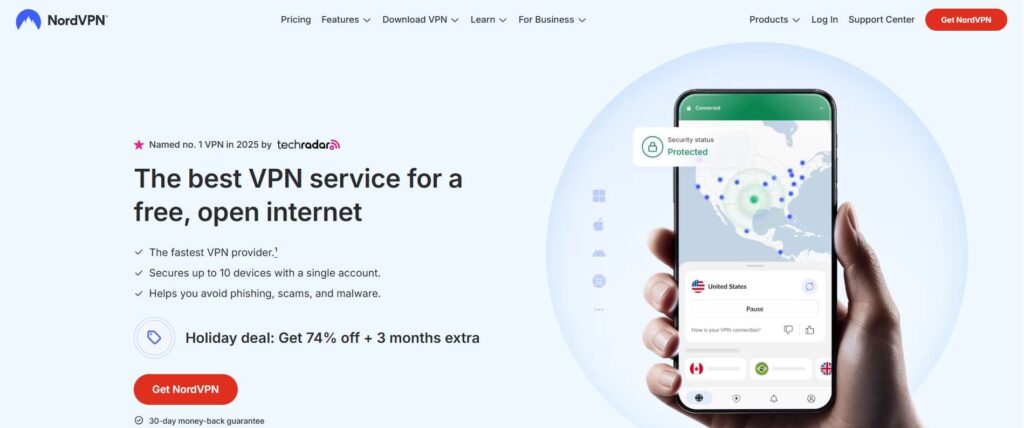
After the security scare, I didn’t want a cheap, unreliable option. I needed the best VPN 2026 had to offer, especially since I was relying on it for communication and safety thousands of miles from home. I settled on NordVPN, and this honest NordVPN review reflects why it became my essential travel companion.

Why NordVPN Is Ideal for Travelers
I needed a VPN that could handle the unpredictable nature of travel connections in a country like Kenya. NordVPN delivered on the three things that matter most to a traveler:
-
Speed: NordVPN’s NordLynx protocol is built on the WireGuard standard, offering blazing-fast speeds. This was critical for uploading the dozens of high-resolution photos I was taking and for stable video calls with my Kenya Wild Safaris guide when discussing itinerary changes. I didn’t notice the internet slowdown I feared.
-
Global Servers: With servers in 111 countries (and growing), I could always find a fast, stable connection. This server network is what allowed me to virtually “go home” to access my bank or “travel” to a different country to access content, giving me true digital freedom.
-
No-Log Policy: This is non-negotiable for privacy. NordVPN has a strict, independently audited no-log policy, meaning they don’t track, collect, or share your private data or browsing history. They simply can’t, which is the ultimate peace of mind when using a VPN while traveling abroad.
NordVPN on iPhone & Android
My primary devices on safari were my smartphone and a small tablet. The VPN experience needed to be effortless.
-
Easy Setup: Downloading the app for my phone was a breeze. I signed up, downloaded the app on my VPN on iPhone, logged in, and was protected in less than five minutes.
-
Battery Efficiency: I was worried about the app draining my phone battery while I was out in the bush with limited charging options. The specialized app design and the NordLynx protocol meant I could keep the VPN active all day for constant VPN for public WiFi protection without significant battery impact.
-
One-Click Protection: The interface is incredibly user-friendly. I just opened the app, tapped “Quick Connect,” and I was instantly secured to the fastest nearby server. If I needed to connect to my home country for banking, a simple search and tap was all it took. This ease of use makes it the best VPN for iPhone and best VPN for Android users who don’t want to mess with settings.
🤖 Using a VPN for ChatGPT While Traveling
A modern traveler relies on modern tools. For me, that meant ChatGPT VPN access. I use AI tools like ChatGPT for quick language translations, itinerary optimization, or even asking for background details on the wildlife I had just seen.
ChatGPT Restrictions by Country
While generally accessible, certain countries or regions may have temporary access issues or block AI services outright due to local regulations. Even when available, some AI services, including specific features of ChatGPT, might be geo-blocked or their performance throttled based on your physical location.
Why Travelers Rely on ChatGPT
As a traveler, I relied on ChatGPT for:
-
Quick Itinerary Planning: “What’s the shortest route between Samburu and Lake Nakuru?”
-
Language Help: “How do I say, ‘Thank you for the wonderful trip’ in Swahili?”
-
Local Knowledge: “What are the traditional uses of the Acacia tree?”
NordVPN Solving Access Issues
NordVPN effortlessly bypassed any of these potential geo-restrictions or throttling issues. By connecting to a server in a country with open and fast access to AI services (like the US or UK), I ensured I could always get the information I needed, instantly, to make my safari more informed and efficient. A VPN for ChatGPT isn’t a frivolous use—it’s maintaining access to the digital tools you rely on for seamless travel.
🎬 VPN for Streaming, Gaming & Apple TV Abroad
While the safari is about unplugging, downtime is inevitable—especially in the evenings at the lodge or during long transfers. A fast, reliable VPN turns that downtime into seamless entertainment.
Watching Netflix & YouTube While Traveling
This is perhaps the most common reason people look for a VPN abroad, and it was a small but significant source of comfort for me.
Geo-Blocked Content
When I tried to access my usual Netflix library, I was met with a much smaller selection of content tailored for the local region. All my familiar shows and movies were gone due to geo-blocked content. This is where a VPN for streaming abroad comes in.
NordVPN Streaming Performance
By connecting to a server in my home country using NordVPN, my Netflix, Hulu, and even YouTube subscriptions instantly reverted to my familiar library. The fast speeds meant zero lag and no buffering on my VPN Apple TV device that I brought for the lodge, ensuring HD streaming quality. NordVPN is optimized for this kind of traffic, making it a truly functional entertainment gateway.
Gaming While Traveling
For travelers who enjoy a bit of online gaming, a reliable connection is paramount.
-
Reduced Lag: By connecting to a VPN server closer to the game’s servers, you can often achieve a better ping (latency), leading to reduced lag and a much smoother gaming experience—a key feature of a quality VPN for gaming while traveling.
-
Secure Gaming Networks: You’re also securing your connection with encryption, protecting your gaming accounts from being hijacked by malicious users on the same unsecured public WiFi.
🦒 How I Use NordVPN During Safari Trips
My day-to-day use of NordVPN quickly became a simple, non-negotiable habit. It moved from a niche tool to a foundation of my secure travel tech. This is how I ensured a seamless experience while focusing on the incredible wildlife around me:
-
Booking Lodges Securely: When making any last-minute arrangements or checking my next booking, I made sure my VPN was active. This protected my payment information and ensured the booking confirmations were sent securely.
-
Communicating with Kenya Wild Safaris Team: When using email or online chat with my Kenya Wild Safaris contact, I was always connected via NordVPN. This added a layer of privacy to our communications and protected my account from interception on shared networks. This sense of trust, experience, and first-hand lessons is part of what makes planning a safari with them so seamless.
-
Uploading Photos Safely: After a morning game drive, I’d often upload the day’s photos to a cloud service. This can be a huge file transfer, and I didn’t want my unencrypted images—or the login details for my cloud service—exposed. Connecting through NordVPN’s secure tunnel meant all that data was transferred safely.
🛑 VPN Mistakes Travelers Still Make
The biggest danger for a new VPN user is a false sense of security. Even with the best VPN for travelers, you have to use it correctly. Here are the common travel VPN mistakes I learned to avoid:
-
Free VPNs: Avoid them like the plague. If a VPN service is “free,” you are the product. They often make money by injecting ads, tracking your data, or selling your bandwidth. For a truly private and safe experience, especially for online banking, a high-quality paid service like NordVPN is the only sensible choice. The cost vs risk ratio is simply not worth it.
-
Not Enabling Auto-Connect: The moment you lose connection (e.g., your device sleeps, the WiFi drops), your data can leak. A critical feature of a premium VPN is the “Kill Switch” and the auto-connect feature, which automatically cuts your internet if the VPN drops and reconnects you immediately when a network is detected.
-
Forgetting VPN on Mobile Data: While mobile data (4G/5G) is generally safer than public WiFi, you still want to maintain your privacy from your local service provider, advertisers, and potential location tracking. I made a habit of keeping my VPN active even when connected to local mobile data for constant protection.
💰 Is NordVPN Worth It for Travelers?
When you weigh the cost vs risk, the answer is an undeniable yes. The price of a premium VPN subscription is negligible compared to the financial and emotional damage of a compromised bank account, identity theft, or being locked out of essential services while abroad.
Cost vs Risk
The initial cost of my two-year NordVPN subscription was less than the cost of one dinner at my safari lodge. The risk I ran—the possibility of being locked out of my bank or having my credit card stolen—was potentially hundreds or thousands of times greater.
Compared to Free VPNs
As detailed above, there is no real comparison. Free VPNs are a security risk disguised as a free service. NordVPN offers unparalleled speed, a vast global network, and a non-negotiable commitment to user privacy.
I now firmly believe that I won’t travel without it. It has become as essential as my passport and my camera gear.
🚀 How to Set Up NordVPN in 5 Minutes
The best part? It’s incredibly fast and easy. Here is a quick VPN setup guide on how to use NordVPN:
-
Sign Up: Go to the NordVPN website and choose your plan.
-
Install App: Download the native app for your device (best VPN for iPhone, best VPN for Android, Mac, Windows, etc.).
-
Enable Auto-Connect & Kill Switch: Go into the settings and make sure the VPN is set to automatically connect when you detect an unknown WiFi network, and ensure the Kill Switch is active.
-
Choose Location: Tap the “Quick Connect” button to connect to the fastest available server, or search for your home country (or another country for streaming/access) and tap to connect.
-
Done! Your internet traffic is now encrypted and secure.
This is the ultimate set-it-and-forget-it digital security for your entire trip.
🔗 Get NordVPN here (my trusted travel VPN)
🗺️ What This Means If You’re Planning a Safari in Kenya
If you are currently planning a safari—and especially if you are considering the expert guidance of Kenya Wild Safaris—please incorporate a premium VPN into your preparation checklist.
Why VPNs are Essential for Safari Travelers
A safari requires focus: focus on the wildlife, focus on your experience, and focus on capturing memories. You do not want to be distracted by banking fraud alerts, geo-blocked services, or slow, insecure internet.
VPNs are essential for safari travelers because they:
-
Protect you on the shared, semi-public WiFi networks you encounter at lodges and airports.
-
Allow you to safely and reliably access critical services like online banking and email.
-
Ensure that you are not blocked from using helpful tools like ChatGPT.
How Kenya Wild Safaris Helps Travelers Stay Safe
At Kenya Wild Safaris, we prioritize your safety—from the quality of our vehicles and the expertise of our guides to the hand-picked, secure lodges we use. Our mission is to help travelers plan safe, seamless safaris. We’ve learned through experience that true travel safety is holistic.
Digital Safety is Part of Travel Safety
Our first-hand lessons, like the one I experienced, are incorporated into the advice we give. We handle the physical logistics so you can focus on the Big Five. Your role is to handle your personal digital logistics. The simplest way to do that is to install and use a reliable VPN. Trust, experience, and first-hand lessons are what drive our commitment to you, both on the road and online.
RELATED: How I Store 5,000 Safari Photos Safely — The Cloud Backup Strategy That Saved My Memories
🌅 Final Thoughts — Learn From My Mistake
My incredible Kenya safari was almost marred by a completely avoidable digital security mishap. I was lucky. The consequence of my negligence was an inconvenience and a major scare, not a total financial disaster.
The main takeaway I want to give you is this: VPNs are no longer optional, especially for international travelers. They are the single most effective, low-cost tool you can acquire to manage the risks of the digital world abroad.
Travel is about discovery and peace of mind. It’s about being fully present in the moment—watching that lion cub or that incredible sunset over the Great Rift Valley. Don’t let digital anxiety or a security scare take that away from you. A VPN is one small tool that gives you massive peace of mind. Get one, use it, and then go enjoy the safari of a lifetime.
Would you like me to help you find the best NordVPN plan, or connect you with the Kenya Wild Safaris team to start planning your secure adventure?